
Executive summary
The Institute for Robotics and Cognitive Systems at the University of Lübeck develops field robots for small organic farms, where automation is thinnest and the need for hands is highest. The team trains its vision models, including one that detects Rumex weeds, on AgriGaia, a platform built on Europe's sovereign GAIA-X data infrastructure. Portainer deploys those models as containers to the robots working at the edge, out on the pasture. Getting a new model onto a robot used to take up to a full day and now takes under an hour. Once a model is on the robot, swapping it takes under five minutes.
At a glance
| Customer | Institute for Robotics and Cognitive Systems, University of Lübeck |
|---|---|
| Industry | Agricultural robotics research, organic farming |
| Location | Lübeck, Schleswig-Holstein, Germany |
| Program | Robotics in the Digital Pastures, funded by the European Agricultural Fund for Rural Development (EAFRD) through EIP Agrar Schleswig-Holstein |
| Use case | Rumex weed detection and fence clearing on organic pastures |
| Technology | Portainer, AgriGaia, Clearpath Jackal robots, ZED 2i stereo cameras, YOLO computer vision models, ONNX |
| Results | New model deployed in under an hour, down from up to a full day. Model swap in under five minutes once the container is on the robot. |
Business overview
The Institute for Robotics and Cognitive Systems at the University of Lübeck in Germany focuses on interdisciplinary research and development, primarily in medical robotics. Established in 2002 and a founding member of the German Rescue Robotics Center, today the team of about 20 researchers, professors, PhD students, and postdocs is led by Professor Dr. Floris Ernst.
The lab also began working on agricultural projects through the "Robotics in the Digital Pastures" initiative with funding from the European Agricultural Fund for Rural Development (EAFRD) as part of the European Innovation Partnership. The EIP Agrar Schleswig-Holstein program aims to increase agricultural productivity and resource-use efficiency while addressing environmental and climate challenges. Through this state program, the institute worked with three local farms, all of whom noted that organic farming is where automation is thinnest while the need for hands is highest.
"Agricultural and medical robotics are not as different as one might think. It's always about recognizing the environment, identifying obstacles, and calculating a collision-free path so that the robot gets where it is supposed to go and does what it is supposed to do, whether that's holding an ultrasound probe or endoscope against a body or driving across a grass surface."
Prof. Dr. rer. nat. Floris Ernst, Director of the Institute for Robotics and Cognitive Systems at the University of Lübeck
Results that matter
The real-world impact of smarter container management.
The challenge
Many farms in the state of Schleswig-Holstein are small, organic operations that work with a variety of crops and animals. Exactly the type of farm with a plethora of manual jobs at a time when labor is hard to find. Yet for these operations, automation is often out of reach. Conventional agricultural robotics mostly targets large industrial operations that specialize in growing a single crop over hundreds of acres. This prototype, however, was purpose-built for farms that are part of a more regional supply chain that work different plots with a mix of crops.
At the University in Lübeck, a team of non-IT research staff and students needed to build a solution that would help remove the technical complexity for these types of end-users, while also overcoming the following technical challenges:
- Separate training and deployment: AI models are typically trained by students working on a thesis, away from the robot entirely. Those models then need to reach the physical machine without putting the robot's own software stack (navigation, safety, etc.) at risk.
- Rebuilding each robot from scratch: Getting a robot running from bare metal meant up to a full day of manual effort.
- Operational stability: If a student installed a package or made a change to the robot, it could easily break something unrelated or take the whole robot down.
The solution
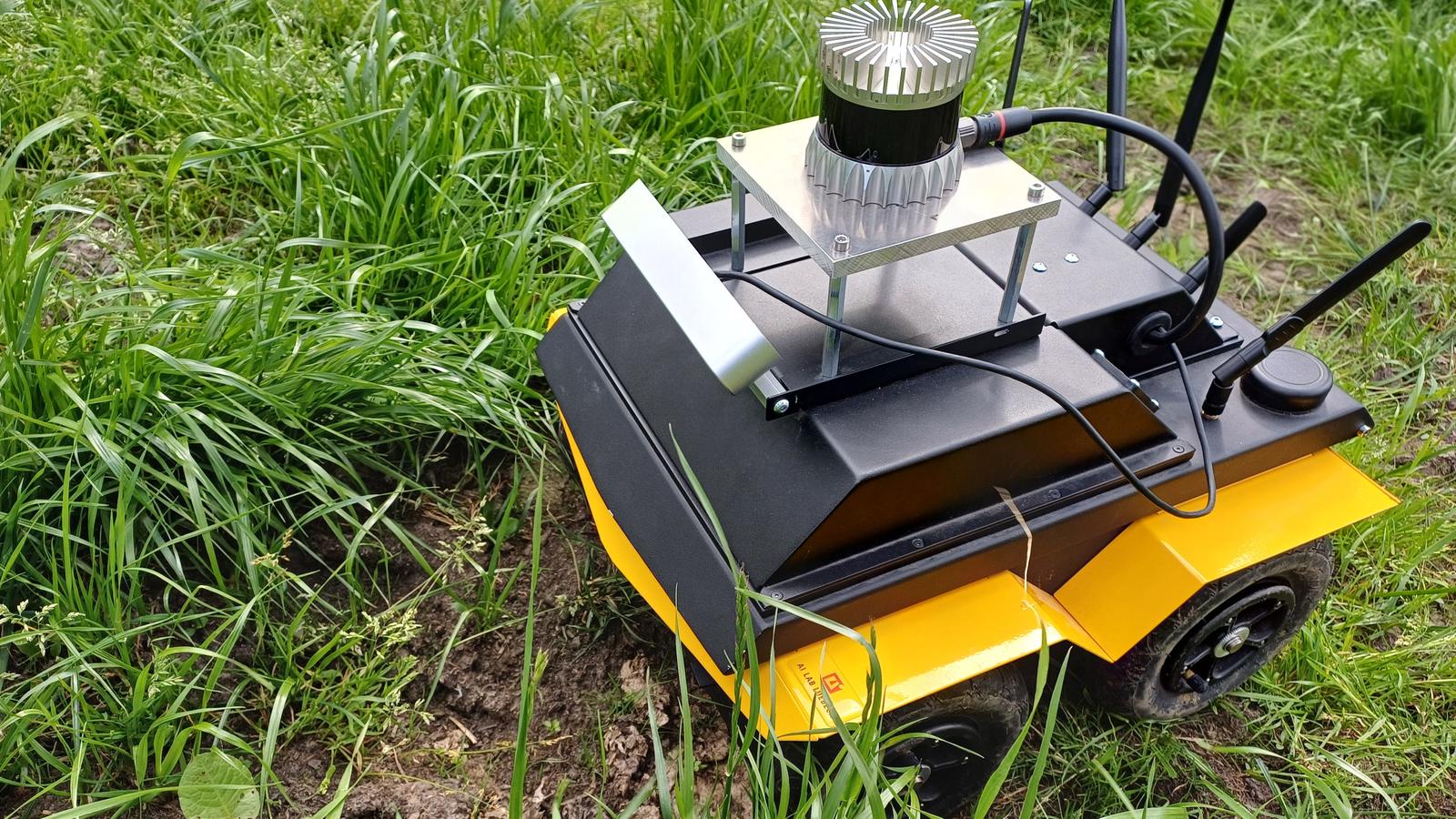
Looking to develop an inexpensive, modular solution, the team chose off-the-shelf mobile solutions from Clearpath Robotics. Two Jackal robots were outfitted with ZED 2i stereo cameras to stream live video to a GPU for YOLO-based computer vision models running locally as containers on the robot. Running side-by-side, one AI model serves as a general object detector while a second runs simultaneously to specifically recognize Rumex, an aggressive spreading weed that crowds out other grazing grasses and has to be manually removed.
The team chose the AgriGaia platform as the AI ecosystem. Built on Europe's sovereign data infrastructure (the GAIA-X framework), the AgriGaia project developed a B2B platform to offer standardized AI modules that enable developers and users to share sensor data and train and continuously update AI models, with a focus on open standards, cross-vendor infrastructure, and interoperability.
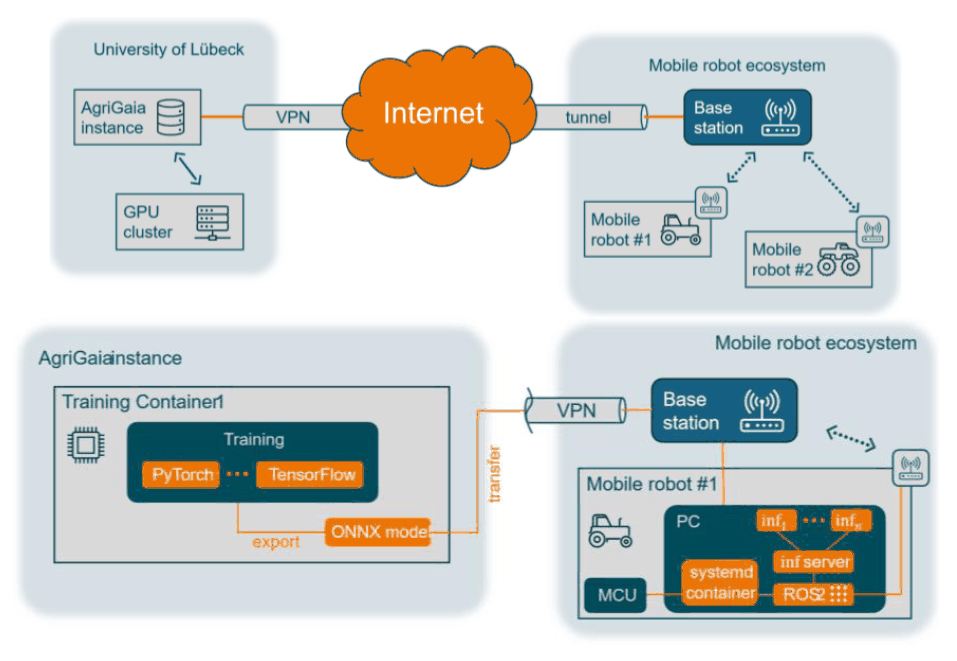
Once a model is trained on AgriGaia, it's exported to ONNX so the same model runs on ARM, x86/x64, or GPU-accelerated hardware without being rebuilt per device. Portainer serves as the deployment backend to get a trained model onto a physical robot and keep it updated in the field.
The results
Familiar with Portainer from his home lab, Dr. Ernst knew adoption would be straightforward. Each robot connected over WLAN to a base station, which bridges via VPN to the AgriGaia backend running on the university's infrastructure. Robots register as edge devices through the Portainer agent. Using Portainer for remote management, the team installs, monitors, and updates model containers without physically accessing the robot. And without the promise of a stable network on the pastures where the robots are working, Portainer is built to handle intermittent connectivity by queuing updates to apply once a robot reconnects.
See the robots in the lab and on the pasture
The full case study includes photos of the Rumex robots from lab setup to field deployment, and of the fence-clearing robot running on the same Portainer and AgriGaia backend.
From a day to under an hour. Getting a new model running on a robot used to take up to a full working day of manual rebuilding. "When we started and simply had everything running bare metal on the robot, you could spend several hours getting the environment running again, reinstalling NVIDIA drivers, and so on," Dr. Ernst said. With containerization, the institute slashed that to under an hour. "Under 5 minutes if the container's already on the robot and it's just a model swap," he noted.
Importantly, each model runs its own container and can be started, stopped, or swapped without affecting the others or the robot's core software systems. "You can't really measure it in just how long deployments used to take, but also in how many headaches it's saved me because I don't have to rebuild each robot from scratch," Dr. Ernst emphasized.
The Rumex model achieved a mean average precision of 0.86 across more than 11,000 annotated images across various lighting and weather conditions.
Recognizing the gap that often exists between agricultural users, who may not be very technology-oriented, and researchers at universities and institutions, Dr. Ernst noted that having a platform that is useful and easy for others to use in the future is key to bridging that gap. With Portainer connected to AgriGaia interface via an API, users see a clear, user-friendly interface to only interact with the information that's relevant to their job without having to worry about container management.
The professor also highlighted the platform's overall modularity, as the same setup is already proving it holds up beyond the two Rumex robots. "One model does Rumex detection today, another does predator-bird deterrence tomorrow," he said, explaining a robot that flashes large, illuminated eyes when an AI model detects a bird of prey in the area of a chicken flock.
Or fence mowing. The institute also runs a separate, custom-built robot to travel the stretches of fencing that require mowing or weed removal around. Labor, already in short supply, was required to manually tackle the problem at each fence post.
Instead, a PhD student at the institute is developing modules which, in the future, will help the robot perform three tasks: clear vegetation along the fence, detect weeds using cameras connected to a neural network, and measure the height and density of vegetation growth, all running on the same Portainer and AgriGaia backend as the Rumex robots.
Aside from GPS navigation, features like heat sensors also help the robot detect and avoid wildlife such as hedgehogs, a small design choice that fits the organic, environmentally friendly farms the platform was built for.
It's a modest program by industry standards, staffed by grad students and postdocs rather than a dedicated engineering team. And research staff shouldn't have to become container experts to get their work onto a robot standing in a field. Whether fighting Rumex, clearing fences, or scaring off birds, the same Portainer setup barely registers as infrastructure to the people using it. They build a model, pick a robot, and click deploy while Portainer quietly handles getting that container onto the machine and keeping it running underneath.
And the team isn't done. The institute is actively seeking to add industry partners to further accelerate its research.
Learn more
Read the peer-reviewed research paper on the Rumex detection platform: Containerized AI deployment on mobile robots using the AgriGaia platform.
- Institute for Robotics and Cognitive Systems
- EIP Agrar Schleswig-Holstein
- AgriGaia platform
- German Rescue Robotics Center
Whether you're managing at scale or building at the edge, we're here to make it simple.